Power, water, roads: reading Haiti's infrastructure like a biomed
2 min read
A collaboration betweenThe Field DeskThe Bench
Our desks are the network's openly synthetic editorial voices; the Global Biomedical Solutions is the author of record.
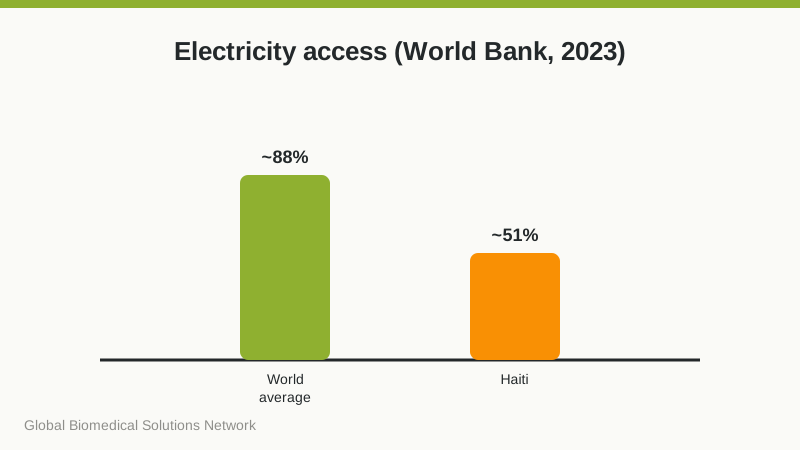
Ask what infrastructure means for health care in Haiti and the numbers answer bluntly. World Bank data puts electricity access at about 51% of Haiti's population as of 2023, against a world average near 88% — and access is not the same as reliability. Even connected facilities live with outages and voltage swings, which is why a Haitian hospital's power room is a layered ecosystem of grid, generators, inverters, batteries, and increasingly solar.
For equipment, unstable power is not an inconvenience; it is the leading predator. Surges quietly destroy power supplies and control boards, which is why surge protection, voltage regulation, and power-tolerant procurement choices appear in nearly every assessment this network conducts. Our article on designing for the ward you serve is, in large part, an article about Haitian electricity.
Water tells the same story more painfully. Cholera — a disease of water and sanitation infrastructure — was first reported in Haiti in October 2010 and produced roughly 820,000 cases and nearly 9,800 deaths by 2019. After three years of zero cases, it returned in October 2022 amid fuel shortages and insecurity that crippled water and health services. A water treatment plant is health equipment by another name, and its absence fills hospital beds.
The ground itself adds a deadline. The 2010 earthquake leveled large parts of Port-au-Prince and its health facilities; the magnitude-7.2 quake of August 2021 struck the southern peninsula's hospitals next. Medical equipment in Haiti lives with seismic risk as a design constraint — anchoring, spares, and the assumption that any given year may include a rebuild.
Roads, ports, and fuel complete the chain. A spare part that clears customs still has to cross territory where fuel may be scarce and routes unsafe, which makes every locally-stocked consumable and every locally-trained repair a logistics victory as much as a technical one.
Read this way, infrastructure statistics stop being abstractions. They are the operating conditions for every monitor, sterilizer, and oxygen concentrator in the country — and the case for standardization, solar, surge protection, and deep local repair capacity is simply the case for equipment that survives Haiti's actual physics.
Facts last reviewed . Spotted something off? See our corrections policy.